
Microneedling with Dermapen
Support your skin's natural renewal process.
Professional microneedling for acne scars, skin texture and skin quality — assessed and delivered by a practitioner.
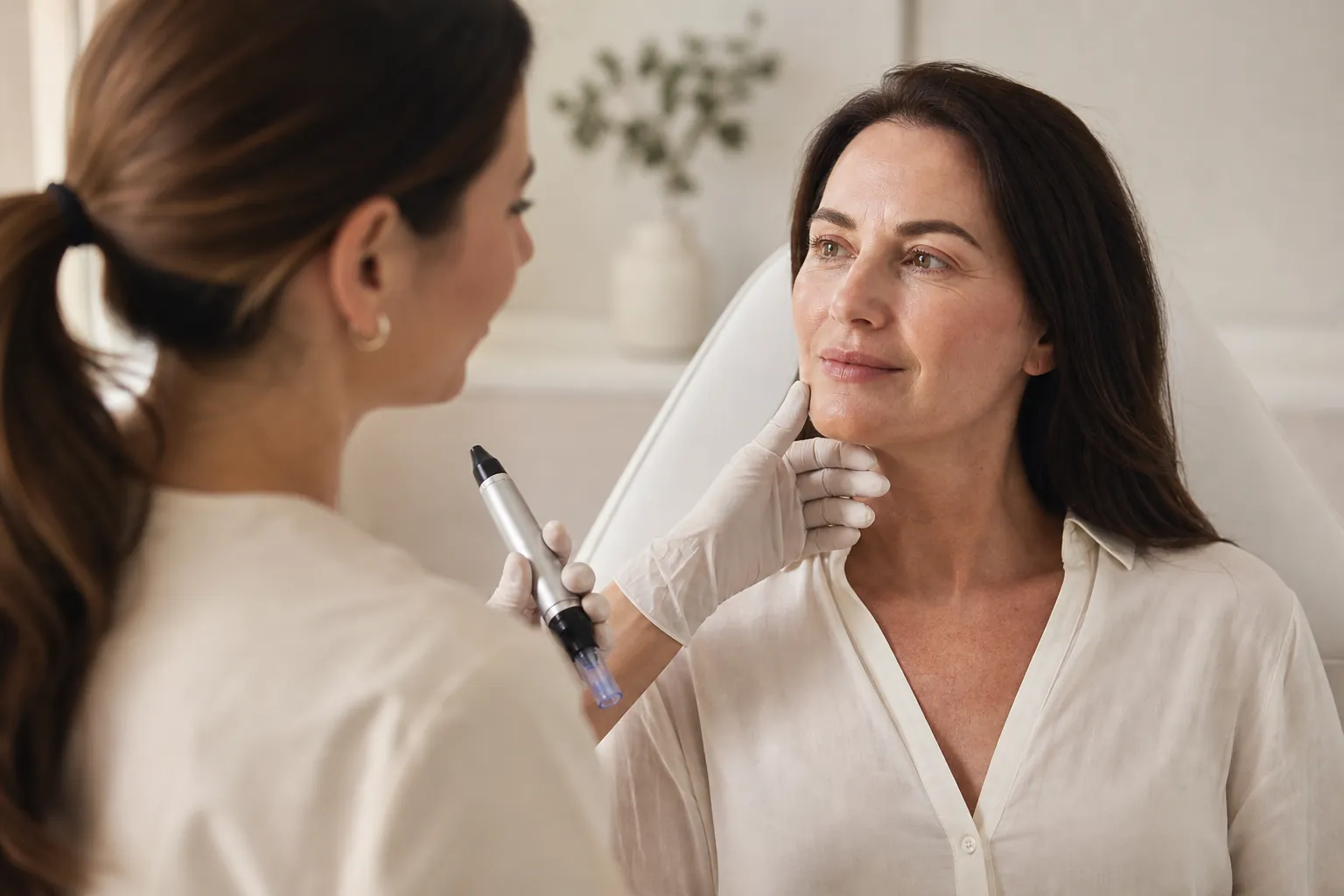
Would you like to improve the appearance of acne scars, uneven skin texture or skin that has lost some of its smoothness over time?
Microneedling is a minimally invasive skin treatment that uses very fine, sterile needles to create controlled micro-injuries in the skin. These controlled injuries stimulate the skin's natural repair response and processes associated with collagen remodelling.
At IDUNN, we perform microneedling using Dermapen, a professional microneedling device that allows the practitioner to control the treatment according to the area being treated and your individual skin needs.
Unlike treatments that remove the surface of the skin, microneedling works by creating controlled microscopic injuries while largely preserving the epidermis.
What can microneedling help with?
Microneedling has been studied most extensively for atrophic acne scars, with systematic reviews of randomized controlled trials reporting improvement following treatment.
Research has also explored microneedling for photoaged skin and broader skin rejuvenation, although the evidence for these indications is less extensive than the evidence for acne scarring.
Depending on your skin and individual suitability, microneedling may form part of an approach to improving acne scars, uneven skin texture, the appearance of fine lines, and overall skin quality and appearance.
Your consultation helps establish which concerns are appropriate for treatment and what you can realistically expect.
What does the science say?
A 2021 systematic review evaluated nine randomized controlled trials and concluded that microneedling was an effective and well-tolerated treatment for atrophic acne scars, either alone or in combination with other treatments. No serious adverse effects were reported in the included studies. The authors nevertheless highlighted the need for larger studies and longer follow-up. [1]
Dermapen itself has also been studied clinically. In a randomized study of 60 patients with atrophic acne scars, Dermapen microneedling produced clinical improvement, while combining Dermapen with Jessner's solution produced greater improvement than either treatment alone. [2]
A 2024 study examining different Dermapen needle depths found improvement in collagen bundles and elastic fibres after six sessions, alongside clinical improvement in acne scarring. [4]
The scientific literature therefore provides a reasonable basis for microneedling as a treatment for atrophic acne scarring, while evidence for general anti-ageing and skin rejuvenation continues to develop. [3]
What happens during treatment
Your treatment begins with a consultation and skin assessment. We discuss what you would like to improve, examine the treatment area and consider whether microneedling is appropriate for your skin.
Your skin is prepared before treatment and the Dermapen device is passed systematically across the selected area, using fine needles to create controlled microscopic channels within the skin.
Treatment parameters, including needle depth, are selected according to the treatment area, skin concern and professional assessment rather than applying the same protocol to every patient.
The skin may appear red following treatment and temporary sensitivity, swelling or discomfort can occur. Your practitioner will explain what to expect and provide personalised aftercare instructions.
Microneedling is generally approached as a course of treatments rather than a single treatment when addressing concerns such as acne scarring. Your practitioner will recommend a programme based on your individual assessment rather than applying a fixed programme to everyone.
The IDUNN approach
Work with your skin, not against it.
Our approach to skin rejuvenation follows the same philosophy as the rest of IDUNN. Less is more.
Microneedling uses a controlled stimulus to encourage the skin's own repair and remodelling processes rather than trying to create an artificial result.
For some people, microneedling may be appropriate. For others, another treatment — or simply a good skincare plan — may make more sense. The consultation helps us decide together.
Frequently Asked Questions
It is studied most extensively for atrophic acne scars. It may also form part of an approach to uneven skin texture, the appearance of fine lines and overall skin quality.
It is generally a course rather than a single session. The number and interval depend on your skin, the concern treated, needle depth and your individual response.
The skin may appear red afterwards, and temporary sensitivity, swelling or discomfort can occur. Your practitioner will explain what to expect and provide aftercare instructions.
Dermapen is a professional device that lets the practitioner control treatment parameters, including needle depth, according to your individual assessment.
No. Unlike resurfacing treatments, it creates controlled microscopic injuries while largely preserving the epidermis.
Not necessarily. Suitability is established at consultation. For some people a different treatment, or simply a good skincare plan, may make more sense.
References
- Sitohang, I. B. S., Sirait, S. A. P., & Suryanegara, J. (2021). Microneedling in the treatment of atrophic scars: A systematic review of randomised controlled trials. International Wound Journal, 18(5), 577–585. https://doi.org/10.1111/iwj.13559
- Ali, B., ElMahdy, N., & Elfar, N. N. (2019). Microneedling (Dermapen) and Jessner's solution peeling in treatment of atrophic acne scars: A comparative randomized clinical study. Journal of Cosmetic and Laser Therapy, 21(6), 357–363. https://doi.org/10.1080/14764172.2019.1661490
- Atiyeh, B. S., Abou Ghanem, O., & Chahine, F. (2021). Microneedling: Percutaneous collagen induction (PCI) therapy for management of scars and photoaged skin — Scientific evidence and review of the literature. Aesthetic Plastic Surgery, 45(1), 296–308. https://doi.org/10.1007/s00266-020-01927-4
- El-Domyati, M., Moftah, N. H., Ahmed, A. M., & Ibrahim, M. R. (2024). Evaluation of microneedling depth of penetration in management of atrophic acne scars: A split-face comparative study. International Journal of Dermatology, 63(5), 632–638. https://doi.org/10.1111/ijd.17006
- El-Domyati, M., Fathi, M. M. E., & Abdel-Aziz, R. T. A. (2024). Atrophic facial acne scars; bilateral comparison of two microneedle devices. Journal of Cosmetic and Laser Therapy, 26(5–8), 129–135. https://doi.org/10.1080/14764172.2024.2433219
Start with a consultation.
We will discuss what you would like to achieve, explain how the treatment works and help you understand what you can realistically expect.
Related treatments
- LipoZero 5DA non-invasive body-contouring treatment for localised fat. Consultation-led, measured, and grounded in realistic expectations.
- Skin RejuvenationAn assessment-led approach to dullness, uneven tone and texture — working with your skin's own renewal rather than resurfacing it aggressively.
- Acne Scar TreatmentTreatment matched to your scar type, with a clear statement of which of your scars are likely to change and which are not.
Further reading
- LipoZero 5D: What Body Contouring Can Realistically AchieveNon-invasive body contouring explained: how it works, what the published research shows, who it may suit, and why expectations matter.
- Microneedling for Acne Scars: What It Can and Cannot DoMicroneedling improves some acne scars well and others barely. Which scar types respond, how many sessions it takes, and darker skin advice.