
Look Better
What Is LipoZero 5D — And What Can Body Contouring Realistically Achieve?
A practical guide to non-invasive body contouring: how it works, what the published research actually shows, who it may suit, and why realistic expectations matter.
The honest question most people are actually asking
If you are reading about body contouring, you are probably not asking "what is the technology?"
You are asking: does this actually work, and what will it realistically do for me?
That is the right question — and it deserves a straight answer rather than marketing language.
This article explains what non-invasive body contouring is, what the published research does and does not show, who it may suit, and why the consultation matters more than the device.
First: what body contouring actually means
Body contouring means treating a specific area of the body with the aim of reducing localised fat deposits and improving its shape or appearance.
This is different from weight loss.
Weight loss affects the body broadly, and where your body loses fat is largely determined by genetics and physiology — not by which area you exercise. This is why targeted exercise does not reliably reduce fat in a specific area.
Body contouring focuses on selected areas — commonly the abdomen, waist and flanks, thighs or arms — where localised fat has remained despite an otherwise healthy lifestyle.
It is not a substitute for healthy eating and exercise. It is an option for specific areas that have proven resistant to them.
What LipoZero 5D is
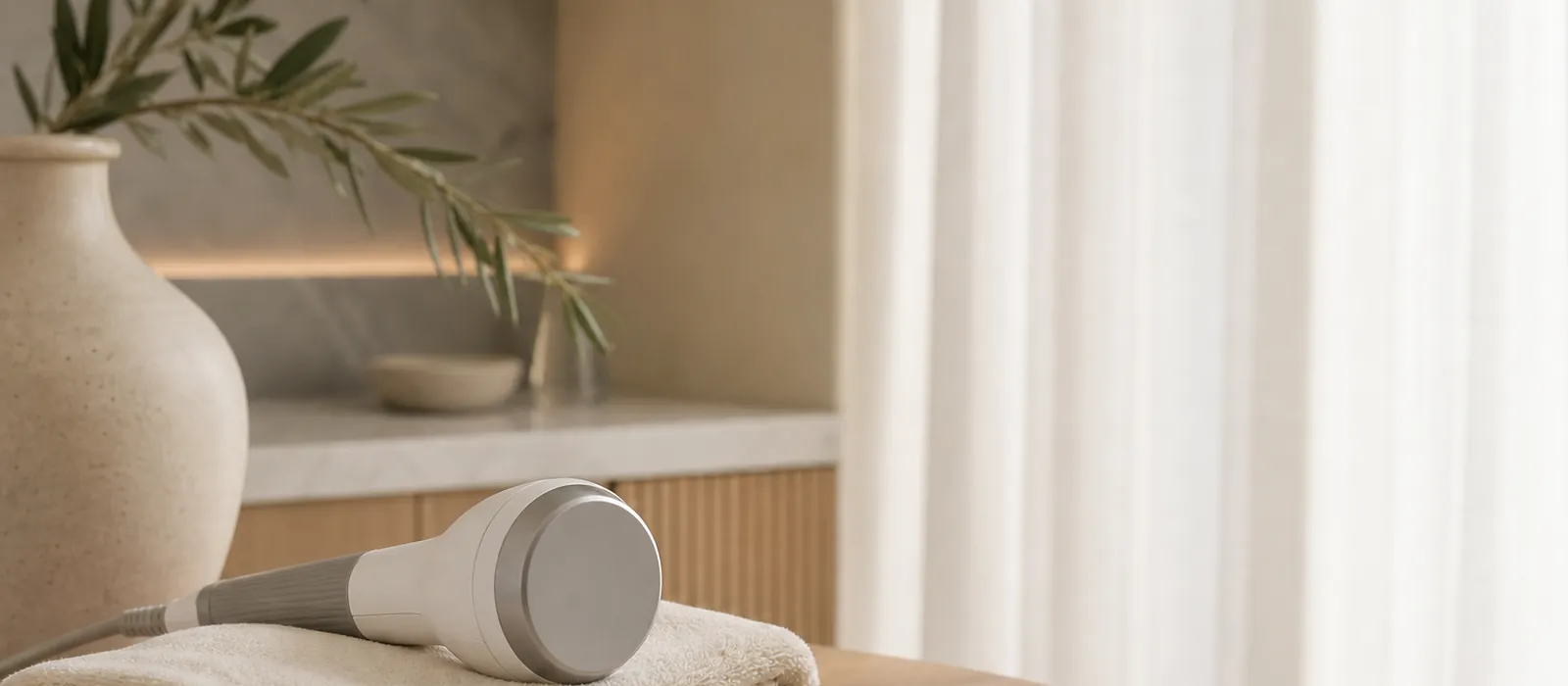
LipoZero 5D is a non-invasive body-contouring system. It requires no surgery, no incisions and no anaesthesia.
It combines five technologies within one treatment platform:
- Multipolar radiofrequency (RF)
- Cavitation
- Vacuum suction
- Low-level laser
- LED
A single session can take as little as approximately 30 minutes, depending on the size and number of areas being treated.
What the research actually shows
This is where most clinic pages go quiet. So let us be specific.
Several of the individual technologies used in modern body-contouring systems have been studied in published clinical research.
Low-level laser therapy (LLLT) has been investigated in randomised controlled trials. Jackson et al. (2009) reported significantly greater reductions in combined waist, hip and thigh circumference following low-level laser treatment compared with placebo.<sup>[1]</sup>
A separate randomised controlled study by Caruso-Davis et al. (2011) examined 40 healthy adults receiving low-level laser treatment to the waist. Among participants whose weight remained relatively stable, repeated treatments produced a statistically significant cumulative reduction in waist circumference, alongside statistically significant improvement in standardised appearance assessments.<sup>[2]</sup>
Cellulite-focused technologies have also been studied. Clinical research involving combinations of radiofrequency, vacuum and mechanical treatment has reported improvements in cellulite appearance and reductions in circumference in treated areas.<sup>[3,4]</sup>
Broader scientific reviews examining radiofrequency, low-level laser, ultrasound and other non-invasive body-contouring technologies have found evidence supporting measurable body-contouring effects — while also noting that outcomes and the strength of evidence vary between technologies, devices and treatment protocols.<sup>[5]</sup>
We would rather tell you that than imply an evidence base that does not exist.
What it can realistically do — and what it cannot
It may help if:
- You have localised fat deposits that have not responded to consistent lifestyle effort
- Your weight is relatively stable
- You want to improve the shape or contour of a specific area
- Improving the appearance of cellulite or skin texture is part of your goal
- You have realistic expectations about the scale of change
It is not the right approach if:
- You are looking for significant weight loss — that is a different objective requiring a different approach
- You expect a surgical-level result without surgery
- Your weight is changing substantially, which makes results difficult to assess meaningfully
- You are expecting permanent results regardless of future lifestyle
Realistic framing matters here. Body contouring produces changes in the contour and circumference of treated areas. It does not reshape the whole body, and it does not replace the role of nutrition and physical activity in overall body composition.
Why it works as a programme, not a single session
Body contouring is generally approached as a course of treatments rather than a one-off appointment.
At IDUNN, depending on the treatment area and individual assessment, we generally recommend approximately 5–6 treatments, typically separated by 3–5 days.
Your individual programme may vary depending on the area, your starting point and how you respond.
Measurement matters more than promises. We take baseline measurements of the treatment area before starting, and repeat relevant measurements during the programme. This means progress is discussed based on what is actually changing — not on assumptions or reassurance.
If the measurements are not moving, that is information worth having, and worth discussing honestly.
Why the consultation matters more than the device
Any clinic can buy a device. What determines whether treatment is worth doing is the assessment that comes first.
A consultation should establish:
- What you actually want to change — which is often more specific than "lose fat"
- Whether this treatment is appropriate for you — and honestly, sometimes it is not
- What a realistic outcome looks like for your starting point
- Baseline measurements so progress can be assessed objectively
- Whether something else would serve you better — for some people, exercise, movement or a change in approach is the more appropriate recommendation
At IDUNN, less is more. Treatment should have a purpose.
If your consultation suggests that lifestyle change would achieve more than a treatment programme, that is what we will tell you — even though it is not the commercially convenient answer.
Questions worth asking any clinic
Whether or not you choose IDUNN, these questions are worth asking:
- Will you take baseline measurements, and will we review them together?
- What result is realistic for my starting point — in measurable terms?
- How many sessions, and what happens if I do not respond as expected?
- What is the evidence for this specific technology?
- Is there anything else that would serve me better than this treatment?
- Who will actually perform the treatment, and what is their qualification?
A clinic confident in its approach will welcome all six.
The short version
- Body contouring targets specific areas; it is not a weight-loss treatment.
- Published research supports measurable effects for several of the individual technologies involved — but not as trials of the complete system, and results vary between individuals.
- It works best as a programme of roughly 5–6 sessions, with measurements taken to track actual change.
- The consultation matters more than the device.
- If a different approach would serve you better, a good clinic will say so.
References
- Jackson, R. F., et al. (2009). Low-level laser therapy as a non-invasive approach for body contouring: A randomized, controlled study. Lasers in Surgery and Medicine, 41(10), 799–809. https://doi.org/10.1002/lsm.20855
- Caruso-Davis, M. K., et al. (2011). Efficacy of low-level laser therapy for body contouring and spot fat reduction. Obesity Surgery, 21(6), 722–729. https://doi.org/10.1007/s11695-010-0126-y
- Hexsel, D. M., et al. (2011). A bipolar radiofrequency, infrared, vacuum and mechanical massage device for treatment of cellulite: A pilot study. Journal of Cosmetic and Laser Therapy, 13(6), 297–302. https://doi.org/10.3109/14764172.2011.630086
- Alster, T. S., & Tanzi, E. L. (2008). Cellulite treatment using a novel combination radiofrequency, infrared light, and mechanical tissue manipulation device. Journal of Cosmetic and Laser Therapy, 10(2), 81–85. https://doi.org/10.1080/14764170802027980
- Mulholland, R. S., et al. (2011). Noninvasive body contouring with radiofrequency, ultrasound, cryolipolysis, and low-level laser therapy. Clinics in Plastic Surgery, 38(3), 503–520. https://doi.org/10.1016/j.cps.2011.05.002
Frequently asked questions
Related at IDUNN
Would you like to discuss your situation?
Tell us what you are experiencing or what you would like to achieve, and our team will help you identify an appropriate next step.
All insights